
Marit is one of our three Easy Read writers and translators. Her job is to write Easy Read documents, often by translating documents clients send to her into Easy Read.
We interviewed Marit to learn more about her job in Easy Read writing.
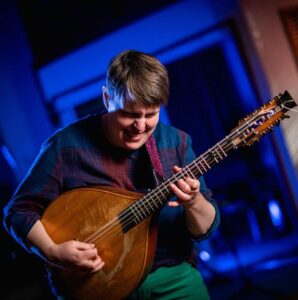
Marit playing a musical instrument called “mandola”. Marit is not only an Easy Read writer but also a musician!
Can you tell me a bit about what Easy Read is?
Easy Read is an accessible way to communicate. It is mostly used to provide information in a simple and clear way. It uses simple language, short sentences, large font and pictures. It was made for people with learning disabilities, but many other people also benefit from it.
What is the first thing you do when you start translating a document into Easy Read?
I read the original document and make sure I actually understand it. Sometimes jargon is necessary – for example when talking about medical terms – but a lot of the time the jargon is not needed at all. I think about the order in which the information is presented and whether it makes sense to change it. I work out what I can remove.
Is there anything that makes translating documents into Easy Read particularly difficult?
If the original document does not communicate very well, it can be difficult to untangle what it is actually trying to say. Sentences like “overseeing the review process” can mean different things depending on the context, and sometimes the original document does not tell you what it means.
Easy Read users may be good at recognising institutional language while still not understanding it. They may have heard words like “assessment”, “review”, “engagement”, “outcomes”, “support plan” lots of times. Familiarity is not the same as comprehension. We have to remember that someone nodding along does not necessarily mean they have understood the information.
How do you go about choosing pictures for your Easy Read text?
This has changed a lot in the last few months, as we have changed image provider. Our images look quite different to what they used to, and I think it makes the overall documents look better!
We now make and compose most of our own pictures in Canva, using images from Canva and BaseSix. It is actually my favourite part of making Easy Read, even though it can be quite difficult. I try to find images of “real” people as much as possible and avoid using too many “model-like” people, but it is not always possible.
Which types of documents are the most fun to translate?
I also work as a musician so I love working on anything to do with the arts. I have been working on a document about a harp player who printed her album cover in braille, and I really enjoyed it!
Is there anything you want to see being put into Easy Read more?
Surveys, documents, reports and similar are all really important documents that rightly should be translated into Easy Read. But I wish there was more creative Easy Read. I would love to see more Easy Read about artists, exhibitions, festivals and I would love to be able to write more Easy Read that is written to entertain, to provide a bit of joy. Music, arts and literature and all creative things should also be made accessible to everyone!
Back to all news ©2026 Disability Equality Scotland